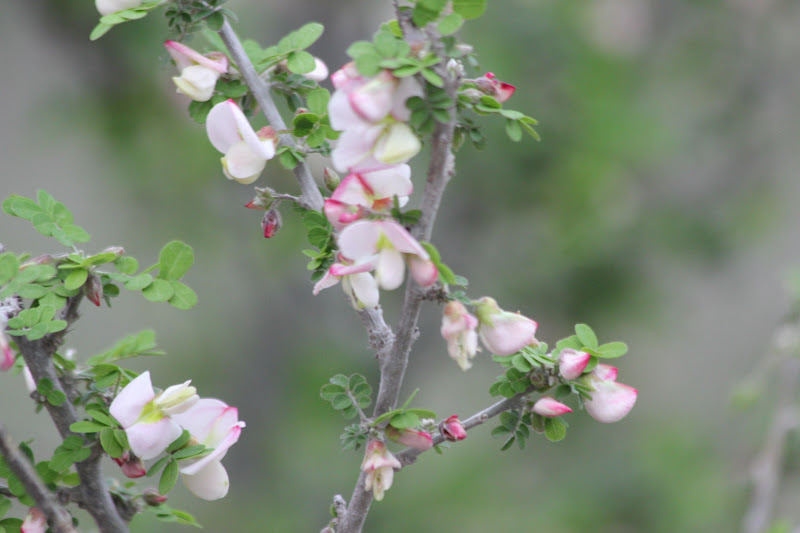
Thursday, March 22, 2012
Our Final Tour for the Season
We had a special tour yesterday with a full van of 14 volunteers. Our tour was to Sabal Palm Sanctuary and our Boca Chica tract that includes the last battle of the Civil War which was fought on what is now refuge land, the Palmito Battlefield.
We arrived at Sabal Palms right on time. I had arranged a special tour for us with a tour of the Rabb Plantation house at 9:30am.
The historian, Larry Lof, does these tours on Saturday, but he was kind enough to give us a special one.
The house is on the way in to the sanctuary and will be their visitor center next year, they say. I have passed it many times in the past, and always wondered about it...now we all know. I am so glad they are restoring it and making it useful again. It has quiet a story.
Mr. Rabb was in the sugarcane business among other things. His first wife was Mifflin Kennedy's granddaughter. He divorced her and she moved to Brownsville and became? an alcoholic. He then married a very young woman. He once owned the historical house called "Rancho de Santa Maria" in Santa Maria and later sold it to a Mr. Hynes. He never had children.
The entry has these two stained glass windows with the initials RS which stands for Rabb, and Starck. His first wife was Lillian Starck. Boy, I bet that other wife liked seeing that on the door!!!
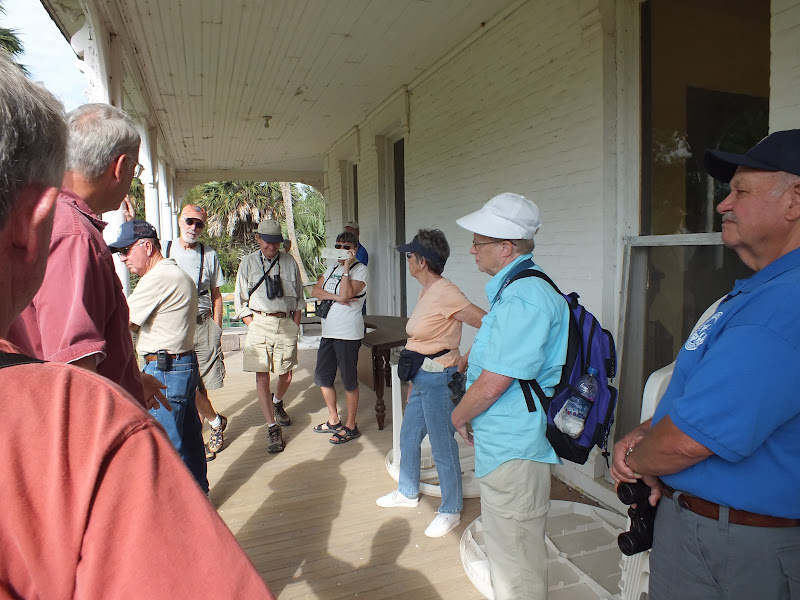
Here we are intently listening to our guide, Larry, while standing on the porch.
Looks like you will need to come back later for the rest of the story. Having technical difficulties. Until later.......
Tuesday, March 20, 2012
La Puerta Project
The La Puerta tract is located east of Rio Grande City just off Highway 83. On the north side of 83 is a small parking lot where visitors can park to access the property by foot only. This tract of land needed water for the wildlife. A plan was made to create a pond to meet this need.
This is Charles, our heavy equipment operator for the refuge. He was called in to dig the hole for the pond. He finished off the edge by piling up dirt on the liner to hold it in place. He made it look so easy!!! It looks GREAT!!!
Plans were made and pipes were laid. Water is supplied by a solar powered pump installed by Wally and Joe with supervision from wetland biologist and supervisor, Imer de la Garza.
Voila...we have water as long as the sun is out and it is for most of the year here in south Texas. We think the wildlife will make good use of this fresh water source as it is one of the three things all critters need to survive...food, water, and habitat.
Here is the proud crew with a job accomplished. Joe, Imer, Wally, and Charles. Our hats are off to you guys!!!
Until next time.....
Thursday, March 15, 2012
Texas Longhorn Cattle
Texas Longhorn Cattle got their start right here in the Rio Grande Valley of Texas. They evolved from cattle that were brought over by the Spanish nearly 500 years ago. To survive this area, cattle had to be hardy. They adapted to the tough conditions by not needing much water and living on sparse vegetation. There are no two alike. Their characteristic horns can have a span of 7 feet. They are the Texas State Large Mammal. Texas is the original home of ranching with most of you being familiar with the King Ranch.
Next time you are in Edinburg, check out these scenes that the highway department put up on the overpass walls. They are really pretty and cost a pretty penny too!!!
The Texas Longhorns were saved from extinction in 1927 when a small herd of stock were sent to breed at Wichita Mountains NWR
in Oklahoma. We are happy to say, we will be spending May, September, and October at this refuge where we will have the opportunity to work with these beautiful animals as well as other things. More on the other things at a later date.
Our seal of the great state of Texas. Can you tell, we are proud!?!
Until next time.....
Sunday, March 11, 2012
Ant Lions
This is the larvae stage of an antlion. It has odd feeding habits. The eggs are laid in sand, and when it hatches, it digs a pit in the sand.
It lives buried in the sand at the bottom with the tips of its powerful jaws exposed. If an ant falls in, it is quickly caught, poisoned, and sucked dry. Have you noticed these little pits in the loose soil???
When you gently scoop the pit up, you can show a child and they are delighted (even adults), as I showed some of the volunteers this little critter today. It is also neat to see them actually capture an ant. Put one in and watch the action!! Small ants work best.
The adult looks like a damselfly, but they will have short knobbed antennae.
Not every pit will have one because it has grown into an adult.
I noticed these out our back window. It looks like Shaggy Mane to me, but the only ones I have seen have grown in clumps. Please comment if you know it is Shaggy Mane.
Isn't nature wonderful? Until next time.....
Thursday, March 8, 2012
Postscript....
Want to mention Mr. John Wallace, our Deputy Project Manager, for all his hard work with this project and all others who were involved. A job well done. Thanks for reviving the area for our wildlife!!!
Until next time....
Until next time....
Bahia Grande Tract
Another volunteers tour with this one being to Bahia Grande (Big Bay). This tract is one that is managed by Laguna Atascosa National Wildlife Refuge, our sister refuge, which is about an hour and a half drive from Santa Ana NWR. There are three refuges that make up the South Texas Complex. The third one being Lower Rio Grande Valley NWR.
Bahia Grande is currently a closed tract to the public, but there are some great plans in the future for this tract of land. We were fortunate to have as our guide, the refuge manager, Leo Gustafson, to give us the tour today. We are standing on one of the bridges that was built with stimulus money, spanning one of the new channels which allowed water into yet another area.
Bahia Grande is the largest estuary restoration in North America. In 1930 when the ship channel was created, this area was cut off. It became a dust basin!!! That created a lot of problems...not only from dirt blowing across the roadway making it difficult driving, but to making people sick. BUT the wildlife suffered too. In 2005, with the help of many partners, a pilot channel was cut allowing tidal water to flow once again. There will eventually be a bigger and deeper cut. This cut can be seen off highway 48 between Port Isabel and Brownsville. Now we have WATER and things are really looking good.
The property was acquired in 1999 and has 21,763 acres with the wetland being 10,000 acres in size.
Here we are looking down one of the new inside channels. This was the day we had wind gusts of 56 mph!!
We saw a lot of Nilgai. The largest Indian antelope. They were brought over here by the King Ranch for hunting purposes in 1930. Both sexes have horns and the male can weigh up to 800 lbs. They have become a problem.
We had lunch at Pelican Island Restaurant where the food is really yummy. You dine while you look out on Laguna Madre where the old railroad trestles can still be seen today.
After a stop at the necessary room, we got seated.
Decisions, decisions, decisions...not for me...it's always fried shrimp!!!
Mark, clowning around...the beer is on its way. Notice the bins even when eating. Mark and Joanie are avid birders and lead our bird walks at Santa Ana.
One last picture. This one is of the old railroad trestle crossing the Bahia Grande on its way to Brownsville. The trestles were made of cypress and are still standing!! The island in the background is Bird Island where there have been many nesting shorebirds and there will be once again when the time comes.
Tuesday, March 6, 2012
This Bouquet is for You
This is a Wild Olive Tree flower. An attractive ornamental plant for the landscape. It will grow as far north as San Antonio, Texas.
This is the flower from the Mountain Laurel Tree. It is an evergreen, and happens to be my favorite. The flowers are very fragrant and smells like grape koolaid. The seeds and leaves are toxic to humans, livestock, and wildlife. The seeds are bright red and are used to make jewelry.
The Anaqua Tree is starting to bloom. After the flowers come berries, a very good source of food for many birds. The wood has been used to make wagon wheels, axles, and wheel spokes.
There are two trees people get confused with. This one is the Retama Tree. The new growth is green much like the Palo Verde Tree. Notice the feathery drooping foliage. Look at the evil long thorn in the picture.
This is the flower from the Palo Verde Tree. You can see the difference in the foliage.
The Honey Mesquite is now blooming and following that there will be an oblong bean that will ripen in late summer. It is an extremely important tree for the wildlife in south Texas. As a bonus, you get an insect...see if you can find it.
Then there is Whitebrush. The flowers are vanilla-scented and the bees are crazy over this plant. Bees make a light colored honey from the flowers, and I really hoped they would be so busy they would not sting me. We came upon this plant at one of the tracts of refuge land called El Ranchito, a tract of land that has some really interesting plants.
Here are Baby Bonnets.
And then there are Baby Blue-eyes.
Then there is Lantana. The crushed leaves have reportedly been used to treat snake bites. It is toxic to livestock and humans.
Couldn't resist this Mexican Hat.
Indian Blanket. (Gaillardia).
Verbena.
We will close with White Prickly Poppy. Until next time.....
Subscribe to:
Posts (Atom)